
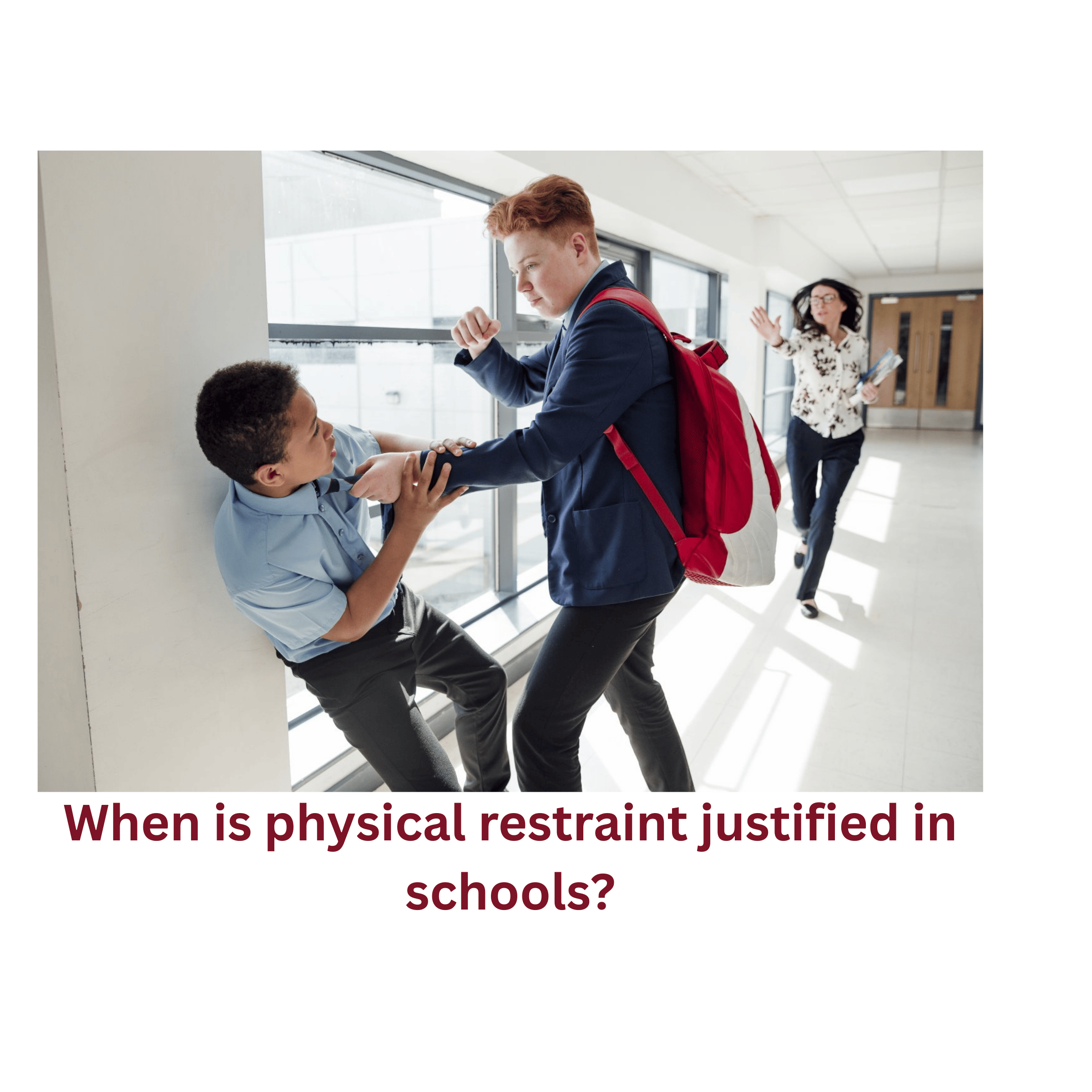
The recent court case concerning the use of restraint in a Northern Territory school reminded me of the need for criteria to determine the justification for a restraint..
The use of physical restraint in schools exposes both staff and students to significant risk. For teachers the risk is that they will be hurt in the attempt to apply the restraint and, even if the restraint is successful (ie the student prevented from harming others) the staff member could be subject to disciplinary measures ie they used undue force or charged with assault. For the student, the risk is that they will be physically hurt and/or psychologically traumatised by the process.
The following are my suggested guidelines about when staff can ‘legally’ apply a restraint. They are based on some 40 years of analysing 100s of assaults on staff by clients in schools, juvenile justice centres and residential child care units (ie resi-care.
I AM NOT A LAWYER SO WHAT FOLLOWS CANNOT BE CONSIDERED A LEGAL OPINION
Put differently I believe that if a teacher restrains a student and the restraint meets the following criteria then that teacher would not be subject to disciplinary action by the school or face legal action for assault etc by the student or their parents.
Criteria for a justifiable physical restraint
The criteria for using restraint are outlined below. Note that the criteria are cumulative – all criteria must be met to justify the use of restraint.
The Criteria
- There is a clear and present danger/threat that is likely to result in substantial harm to staff, the client themselves or a third party and
- There is no other option to mitigate the danger/threat and
- Staff have the physical capability of affecting the restraint with only limited risk of substantial harm to themselves then
- Staff can use reasonable force to restrain the client (ie the force is proportional to the threat)
Caveat: if the violent behaviour constitutes ‘a pattern of behaviour’ then the school must be able to demonstrate that they have put in place measures to prevent the need for restraint ie even if a restraint meet the above criteria but the behaviour constituted a ‘pattern of behaviour’, the school COULD be at risk for not mitigating the need for a restraint.
Operational Definitions
Clear and present danger
- The threat or danger will occur in the next 3-5 seconds.
Substantial harm
Assaults on staff by clients + client assaults on other clients
- Substantial harm is defined as ‘likely to require medical attention’ if the threat is carried out
Self-Harming situations
- In this context ‘substantial harm’ is defined as ‘likely to result in the death or serious injury to the client in the next 2-3 minutes’.
No other option to mitigate the danger/threat
- The key assumption is that all other reasonable attempts to mitigate the situation have either been undertaken or there was no time to undertake such actions.
- This would include attempting to distract the client, removing clients or other people from a dangerous situation, de-escalation etc
- In some situations it is not possible to mitigate the danger or threat because the staff member is physically cornered and therefore cannot take evasive action.
- Prevention: where the violent behaviour is a pattern of behaviour the school should put in place measures to prevent such behaviour from occurring again
Staff have the physical capability of implementing the restraint with only limited risk of substantial harm to themselves
- This mainly applies to ‘client on client’ assaults or when a client is self-harming.
- Normally, Duty of Care does not require staff to physically intervene in the situation, but they must take some other actions to prevent harm to others.
- Many staff, regardless or fitness, age or size may choose to restrain clients regardless of the risk to themselves.
- There is no requirement for staff to physically intervene in these situations.